
Home / Certification / Postural Assessment × SPINEFITTER Movement Intervention
Assessment × structure × intervention
Postural Assessment × SPINEFITTER Movement Intervention
Stop treating the victim. Find the culprit.
When a movement can’t be performed, the cause is rarely a lack of strength. It is usually an imbalance between structural alignment, sensory feedback and motor control strategy.
This course gives you a consistent, repeatable assessment logic — from bony landmarks to movement intervention — and a defensible order in which to act on it. What it emphasises is not whether a single muscle is strong or weak, but how the body, under gravity, chooses the strategy that costs least — and not necessarily the one that works best.
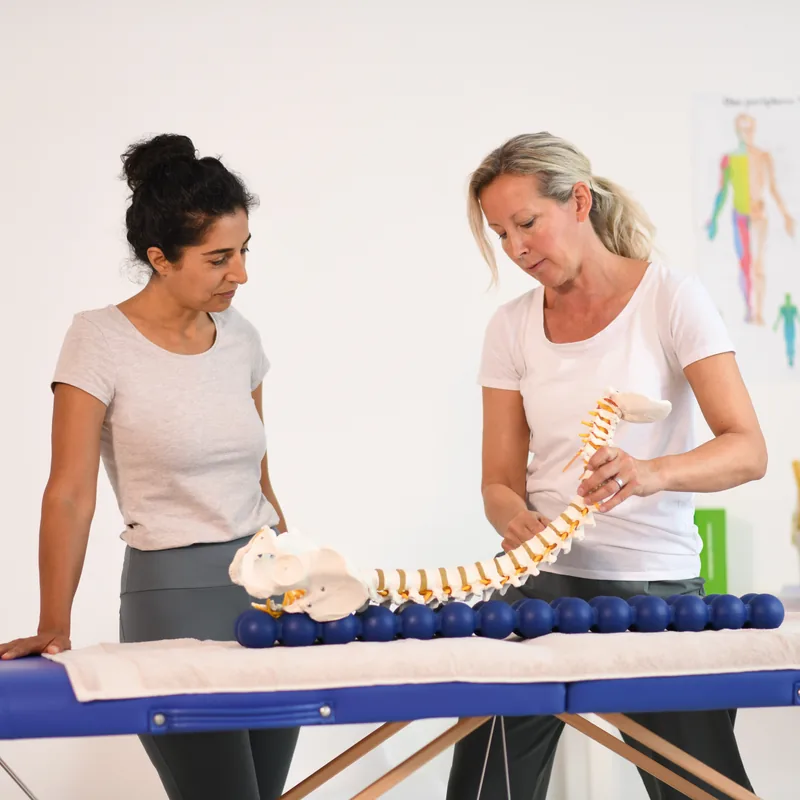
Who should attend
Practitioners who already have a professional background: Pilates instructors, physiotherapists, strength and rehabilitation coaches, and movement professionals working with recurring or complex presentations.
What you will learn
- Build a standardised postural assessment SOP
- Read common compensation patterns from bony landmarks and force lines
- Integrate static posture findings with dynamic test results
- Select when and how to apply SPINEFITTER movement intervention
- Design training that follows Release → Activate → Integrate
- Avoid reinforcing incorrect compensation during training
Course outline
Modules
| # | Module | Content |
|---|---|---|
| 01 | Assessment logic | What postural assessment is for, and what it is not |
| 02 | Bony landmarks and force lines | Reading alignment from structure |
| 03 | Static and dynamic assessment | Integrating the two |
| 04 | The compensation chain | Identifying where the strategy breaks down |
| 05 | SPINEFITTER as intervention medium | Timing and selection |
| 06 | The RAI sequence | Release → Activate → Integrate |
| 07 | Case application | Programme design |
Where the SPINEFITTER fits — and where it doesn’t
The SPINEFITTER is not a tool for correcting structure. In this course it functions as a movement intervention medium: proprioceptive input to the spine and adjacent segments; restoring segmental mobility and reducing excess compensatory tension; a reset and reposition tool used before motor control is rebuilt; a way for a client to feel the correct position and stacking, rather than bracing their way into a posture.
It is always used after assessment and toward a defined objective — never as a standard routine.
Common errors this course is designed to prevent
- Strengthening scapular stability while the thoracic spine is still stiff
- High-intensity core training while the pelvis is not yet controlled
- Demanding lower-limb alignment while foot and ankle support is insufficient
Educators
Healience Lab Academy
HLA Sr. Educators & Educators
Courses are taught by the HLA Sr. Educators and Educators from Korea, Taiwan and China. Meet the educator team →
Certification & materials
International instructor certification, issued through the HLA certification system.
- Course handbook
- Equipment provided during the course
- Certificate on completion
Upcoming sessions
The first Chinese session is planned for October 2026
Dates, city, venue, fee and places will be published here. Register your interest and we will notify you when registration opens.
No session is open for registration yet.
FAQ
Do I need the SPINEFITTER certification first?
No. The five certifications sit at the same level and have no prerequisite between them. This course assumes a professional background rather than prior SPINEFITTER training.
Is there an exam?
Assessment is practical and takes place during the workshop.
Does the certification expire?
No. Further certifications build on it rather than replace it.
What does the certification allow me to do?
Deliver classes in this method — in person and online — and supply SISSEL® products to the people you work with. It is the first step on the path to Educator.
Products taught in this course
The methods and tools presented in this course are intended for general health promotion and professional movement education. Application must be adjusted to the individual. Where disease, pain or injury is present, assessment by a qualified medical practitioner is required.